
Balancing the Scales
Why Some Careers Accelerate – And Others Stall
Why visibility and sponsorship, not support alone, determine who advances into leadership.
Cultivate Sponsorship: Activating visibility, advocacy, and advancement for underrepresented and high-potential talent – so organisations retain and promote leaders from within.
Inside This Month’s Edition
- Why support alone does not shift power
- International Women’s Day: recognition or movement?
- Key insights from the ALGA International Women’s Day keynote
- AECOM WARRA 2026 sponsorship program begins
- What we’re paying attention to this month
From the Desk of Katriina Tähkä, Founder & CEO
Balancing the Scales: Why Advocacy Changes Outcomes
When Support Isn’t Enough
Every March, organisations pause to recognise progress.
Panels are hosted. Campaigns are launched. Commitments are reaffirmed.
But one question often remains unanswered:
what actually moves opportunity inside organisations?
Over the years I have sat in hundreds of conversations with leaders and emerging talent across engineering, construction and professional services. Again and again the same pattern appears. Capability exists. Commitment exists. Ambition exists. Yet opportunity does not always move in the same direction.
This is rarely about intention. Most leaders genuinely want to see talented people succeed. The challenge is structural. Career momentum is not driven solely by capability or effort. It is shaped by visibility, advocacy and the informal signals that determine who is considered ready for the next step.
Development builds capability. Advocacy creates opportunity.
That distinction sits at the centre of this month’s theme. If power does not move, equity does not progress. And power moves when leaders choose to advocate.
Once organisations recognise talent and begin to see the cultural patterns shaping visibility, the next question becomes unavoidable: who is advocating for that talent when opportunity appears?
Research consistently shows that informal sponsorship relationships influence leadership progression more strongly than development programs alone. Sponsorship works because it changes access – to opportunity, visibility and advocacy.
Research from the Center for Talent Innovation found that professionals with sponsors are significantly more likely to gain stretch assignments, build senior leadership visibility and move into leadership roles. In fact, professionals with sponsors are about 23% more likely to advance in their careers than those without one.
The impact extends beyond the individual being sponsored. Senior executives who actively sponsor rising talent are 53% more likely to be promoted themselves, highlighting how developing others is also recognised as a leadership capability.
Sponsorship also changes the type of opportunities leaders receive. Research shows that middle managers with protégés are up to 167% more likely to receive stretch assignments than those without them – the kinds of experiences that build credibility and accelerate leadership readiness.
The message is clear: advocacy is not an optional extra in leadership development. It is a structural lever that changes outcomes.
Which raises an important question during International Women’s Day conversations: are we celebrating talent – or advocating for it?
International Women’s Day: Recognition or Movement?
International Women’s Day has become an important moment of visibility for women’s achievements. Organisations highlight role models, celebrate progress and reaffirm commitments to equity.
These moments matter. But they also raise a leadership question organisations rarely ask: what changes after the event ends?
Many organisations have become increasingly effective at supporting talent through mentoring, coaching and professional development initiatives. These investments build confidence and capability, yet they do not always translate into leadership mobility.
The difference lies in how opportunity moves through organisations.
Mentors advise and support growth. Sponsors actively advocate. They use their influence to ensure that capability is recognised in the rooms where decisions are made. They attach their credibility to someone’s potential and ensure that individual is considered when opportunities arise.
Mentorship develops people. Sponsorship moves careers.
This distinction matters because leadership representation rarely changes through development alone. According to McKinsey’s Women in the Workplace research, the most significant drop in representation occurs at the first step into management. This “broken rung” creates compounding effects across the leadership pipeline.
If organisations want representation to shift, advocacy must become a leadership responsibility rather than an informal or accidental behaviour.
Why Mid-Career Women Are the Real Retention Challenge in STEM
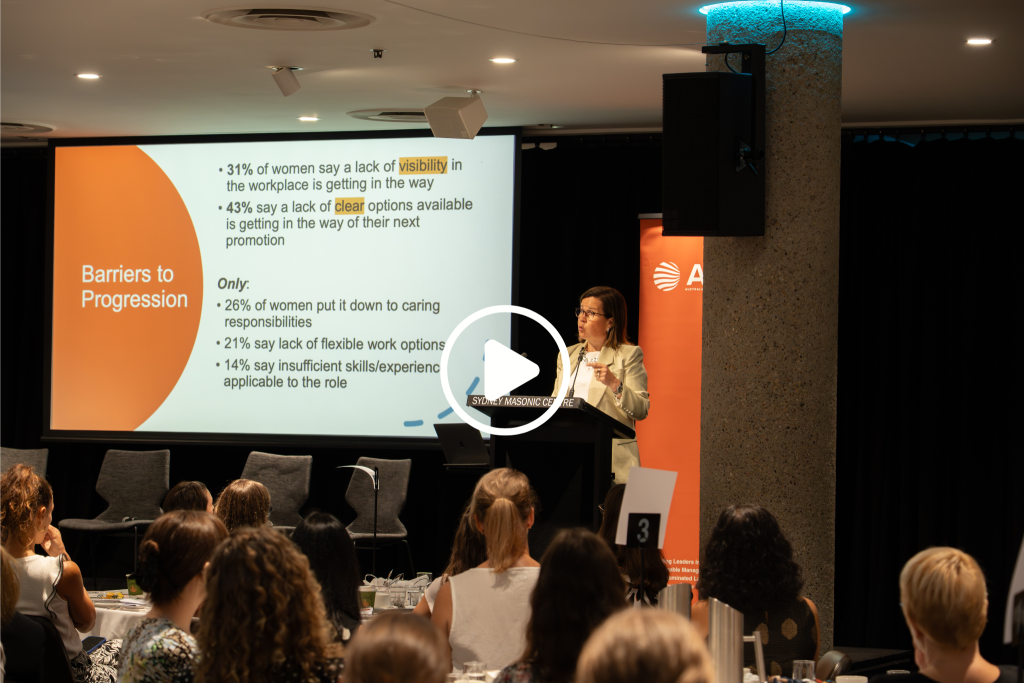
Last week I spoke at the Australasian Land & Groundwater Association (ALGA) International Women’s Day breakfast, addressing a challenge many STEM industries are quietly confronting.
Much of the public conversation about women in STEM focuses on attracting more women into technical fields. Yet the deeper challenge often lies elsewhere: retaining and advancing the talent already there.
Early in their careers, many women enter STEM professions enthusiastic, capable and committed. However, as careers progress, the path forward can become less visible. Leadership opportunities become more informal, key decisions happen in rooms they are not in, and the signals that indicate readiness for advancement become harder to interpret.
Over time, many talented professionals step sideways or leave the industry altogether. This rarely happens because of a lack of capability. More often, it occurs because the pathway to leadership becomes unclear.
This challenge is particularly pronounced in fields such as environmental science and engineering, where many professionals work within consultancies, subcontractor networks or smaller firms. In these environments, formal leadership development pathways may be limited. Careers are therefore shaped less by structured processes and more by everyday interactions between people.
Career momentum is rarely defined by a single moment. Instead, it emerges from a series of smaller decisions: who is invited into important conversations, who is trusted with stretch opportunities, and who is spoken about when new opportunities arise.
For years the leadership conversation has focused on allyship, and awareness remains important. Yet sustained career progression often requires something more active. Sponsorship involves leaders using their voice, credibility and influence to advocate for someone when that person is not present.
Industries such as environmental science and engineering depend not only on attracting talented professionals but on ensuring those professionals continue to see a future for themselves within the field.
I closed the session with a simple message for leaders: notice talent, name it and back it. Careers rarely move by accident. They move when leaders choose to advocate.
One way organisations are beginning to address this challenge is through structured sponsorship.
Here’s a sneak peek from the ALGA International Women’s Day breakfast.
AECOM WARRA 2026: Sponsorship in Action
One way organisations are turning advocacy into action is through structured sponsorship.
Later this month, on 26 March, the AECOM Warra 2026 Cultivate Indigenous Sponsorship Program begins.
A partnership that continues to grow
We are excited to commence this important program with AECOM, building on a partnership that has continued to grow since 2019. Over the past six years we have had the privilege of working together through the WILLOW and WARRA programs, supporting leaders across the organisation to strengthen capability, connection and opportunity.
This next program continues that shared commitment, creating space for emerging leaders to build influence, expand their networks and step forward into the opportunities ahead.
Why sponsorship matters
WARRA by Cultivate Indigenous continues to demonstrate how structured sponsorship can strengthen leadership pipelines across engineering and infrastructure. This new cohort brings together senior leaders and high-potential professionals ready to build sponsorship relationships that accelerate visibility, advocacy and opportunity.
The beginning of every program reveals something important. Sponsors start to see talent differently, and participants gain insight into how leadership narratives are shaped within organisations. Conversations that rarely occur in traditional development settings begin to surface.
What participants say
Participants from previous cohorts often speak about the power of the relationships formed through the program.
“Broadening your network, obviously with senior leaders, but also with this cohort of emerging leaders as well, which is great.”
– AECOM Advocate Sponsee
Sponsors also describe the program as a moment for reflection and renewed perspective on leadership.
“Discover new things both about myself, but also importantly, I get some fantastic insights into the next generation of leaders across our business. And it does make me sort of reflect and give me a moment to sit back and think about both legacy and career.”
– AECOM Advocate Sponsor
What we’re seeing across cohorts
Across Cultivate cohorts, participants consistently report stronger executive visibility, greater confidence navigating promotion conversations and a clearer understanding of how leadership opportunities move within their organisations.
As the WARRA program unfolds this year, we look forward to sharing the insights and outcomes emerging from the cohort – and continuing to explore how sponsorship can shape stronger, more visible leadership pathways across the industry.
What We’re Paying Attention To
These articles, podcasts and talks explore how visibility, sponsorship and advocacy shape leadership progression.
🎧 McKinsey Talks Talent: When the career ladder breaks for women – McKinsey & Company
McKinsey talent experts discuss leadership development, workplace equity, and building stronger talent pipelines for the future of work.
📚 Mentors are failing to accelerate women’s careers: But there’s a solution – Cultivate Sponsorship
Why mentorship alone won’t move the needle on women’s careers – and what will.
📹 Inside the Cultivate Sponsorship Program with Adam & Rachel from AECOM – Cultivate Sponsorship
Here directly from past participants on the two-way sponsorship relationship that drove significant outcomes for them both.
🔁 Carla Harris – How to Find the Person Who Can Help You Get Ahead at Work – TED Talk
A talk worth revisiting. Carla Harris explains why career advancement often depends on sponsorship – someone willing to advocate for you in rooms you’re not yet in.
Final Thought
March often centres on celebrating progress. At Cultivate, we focus on the mechanisms that create it.
Support builds capability. Advocacy moves opportunity.
Because leadership outcomes rarely change by accident. They change when leaders choose to advocate.
Balancing the scales is not about symbolic gestures or one-off initiatives. It is about building leadership cultures where visibility, advocacy and opportunity are part of everyday decision-making.
Mentorship develops people. Sponsorship moves careers.
- Book your Pinpoint Strategy Session
- Explore all Cultivate Services
- Download the Social Impact Report